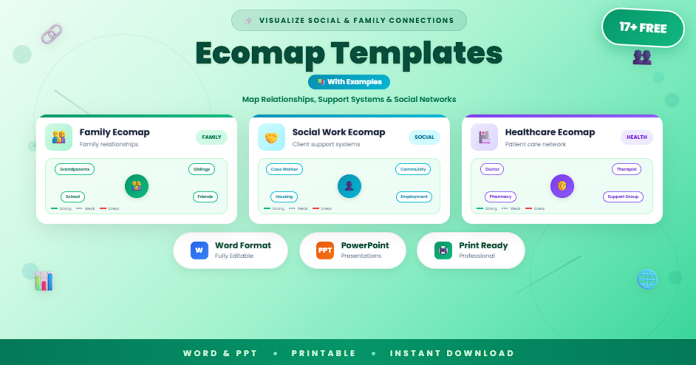

Ecomaps are practical visual tools for understanding how individuals or families interact with the people, services, and systems around them. They are widely used in social work, counseling, education, healthcare, and community support planning.
Building ecomaps from scratch can take time and may lead to inconsistent documentation. Free editable ecomap templates and examples in Word and PPT provide structured, reusable layouts that help professionals map relationships clearly and communicate case context more effectively.
This guide includes 17+ free editable ecomap templates and examples for assessment, intervention planning, case discussions, and multidisciplinary collaboration.
What Is an Ecomap Template?
An ecomap template is a visual relationship-mapping framework that places an individual or family at the center and maps connections to external systems.
A typical ecomap includes:
- Central individual/family unit
- External systems (school, work, healthcare, relatives, community groups, agencies)
- Connection lines showing relationship type
- Indicators for supportive, stressful, or weak relationships
- Notes for context and intervention priorities
Ecomaps help professionals quickly identify support networks and pressure points.
Why Use Free Editable Ecomap Templates and Examples?
Using free editable ecomap templates and examples improves clarity, consistency, and collaboration.
Key benefits include:
- Faster case visualization and documentation
- Clear mapping of support systems and stressors
- Better communication across multidisciplinary teams
- Easier identification of intervention opportunities
- Editable structure for different populations and settings
- Useful for both assessment and follow-up reviews
Templates improve both case understanding and action planning quality.
17+ Free Editable Ecomap Templates and Examples (Word, PPT)
Below is a curated collection of ecomap templates and examples, organized by context and use case.
Core and General Ecomap Templates (1–6)
- Standard Family Ecomap Template
- Simple Editable Ecomap Layout
- One-Page Relationship Mapping Ecomap
- Support and Stress Ecomap Template
- Blank Ecomap Worksheet (Word)
- Professional Case Ecomap Example
Social Work, Counseling, and Healthcare Ecomaps (7–12)
- Social Work Assessment Ecomap
- Child and Family Services Ecomap Template
- School Counseling Ecomap Example
- Mental Health Support Network Ecomap
- Healthcare Case Management Ecomap
- Crisis Intervention Ecomap Template
Education, Presentation, and Team Collaboration Ecomaps (13–17+)
- Classroom/Student Context Ecomap
- Community Resource Mapping Ecomap
- Multidisciplinary Team Case Ecomap (PPT)
- Editable Ecomap Presentation Slide (PPT)
- Intervention Planning Ecomap Template
- Complete Editable Ecomap Templates Pack
Why Use Word and PPT Formats?
Word and PPT formats support both documentation and communication needs.
Format advantages include:
- Word: Best for case notes, printable records, and editable assessment forms
- PPT: Best for visual case presentation, team meetings, and training sessions
Using both formats helps teams document clearly and present insights effectively.
Best Practices for Creating Effective Ecomaps
To maximize value from ecomap templates:
- Define the central person/family clearly
- Include all major external systems influencing outcomes
- Use consistent line styles for support, conflict, or weak ties
- Add short notes for relationship context
- Update the ecomap as circumstances change
- Use the map to guide specific intervention actions
An ecomap is most useful when it is current, focused, and actionable.
Common Mistakes to Avoid
When building ecomaps, avoid:
- Omitting key systems that affect the case
- Using unclear or inconsistent relationship symbols
- Overcrowding the map without prioritization
- Treating the ecomap as static after initial assessment
- Not connecting map findings to intervention planning
- Sharing maps without proper confidentiality safeguards
Clarity, accuracy, and ethical handling are essential.
Frequently Asked Questions
What is the main purpose of an ecomap?
To visualize relationships between an individual/family and surrounding systems, highlighting supports and stressors.
Who commonly uses ecomap templates?
Social workers, counselors, educators, healthcare professionals, and case managers.
Can ecomaps be edited for different case types?
Yes. Editable Word and PPT templates can be adapted for child, adult, school, and clinical settings.
Are ecomaps only for family cases?
No. They can map individual support networks, community interactions, and institutional relationships.
How often should an ecomap be updated?
Any time major relationship, service, or environmental conditions change.
Conclusion
Ecomaps make complex relationship systems easier to understand and act on. The 17+ free editable ecomap templates and examples in Word and PPT in this guide provide practical tools for assessment, communication, and intervention planning across social, educational, and healthcare contexts.
With the right ecomap template, professionals can identify critical support pathways, address stress points, and make more informed case decisions.

