
Understanding story structure is an essential part of reading comprehension and literature analysis. Teachers often use plot diagrams or plot pyramids to help students visualize how a story develops from beginning to end.
A plot diagram breaks a story into key stages such as the introduction of characters, the buildup of conflict, the turning point of the story, and the final resolution. These stages help students analyze how events unfold and how characters respond to challenges.
Plot diagrams are commonly used in language arts classes, literature studies, and creative writing exercises to teach narrative structure and story development.
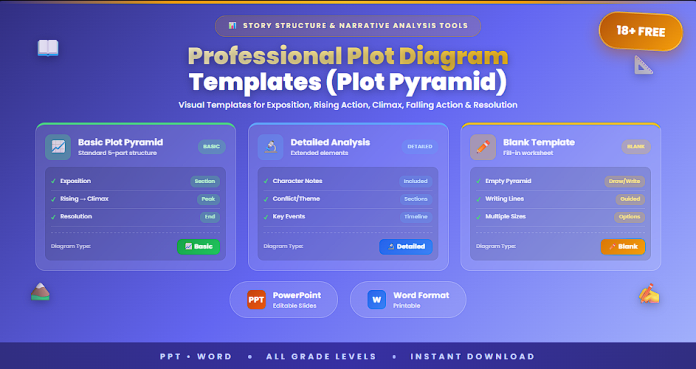
Using free professional plot diagram templates (plot pyramid) in PPT and Word helps teachers and students organize story elements clearly while making literature analysis easier to understand.
In this guide, you will find 18+ plot diagram templates and plot pyramid worksheets designed for classroom use, storytelling analysis, and creative writing activities.
What Is a Plot Diagram?
A plot diagram, also known as a plot pyramid, is a visual representation of a story’s structure. It shows the sequence of events that occur in a narrative from beginning to end.
The plot pyramid helps students identify the major stages of a story.
A typical plot diagram includes the following elements:
• Exposition – Introduction of characters, setting, and background information
• Rising Action – Events that build tension and develop the conflict
• Climax – The turning point or most intense moment in the story
• Falling Action – Events that occur after the climax
• Resolution – The conclusion or outcome of the story
This structure helps readers understand how a narrative develops.
When Should Plot Diagram Templates Be Used?
Plot diagram templates are commonly used in educational settings to help students analyze stories and understand narrative structure.
They are often used for:
• Literature analysis assignments
• Reading comprehension activities
• Creative writing exercises
• Story structure lessons
• Book report analysis
• Narrative storytelling workshops
Using templates helps students break down stories into clear stages.
18+ Free Professional Plot Diagram Templates (Plot Pyramid) (PPT And Word)
Below is a categorized collection of plot diagram templates for classroom and storytelling activities.
Basic Plot Diagram Templates (1–6)
• Simple Plot Diagram Template
• Basic Plot Pyramid Worksheet
• Printable Story Structure Diagram
• Student Plot Analysis Template
• Standard Plot Pyramid Chart
• Basic Story Plot Diagram
Classroom Plot Pyramid Worksheets (7–12)
• Literature Plot Analysis Worksheet
• Story Structure Plot Pyramid Template
• Narrative Plot Diagram Worksheet
• Classroom Story Mapping Template
• Reading Comprehension Plot Diagram
• Story Events Plot Pyramid Chart
Advanced Plot Diagram Templates (13–18+)
• Plot Diagram with Character Development Section
• Detailed Story Plot Pyramid Template
• Narrative Structure Analysis Worksheet
• Story Conflict and Resolution Diagram
• Plot Diagram for Creative Writing
• Complete Plot Pyramid Template Pack
Key Elements of a Plot Pyramid
A plot pyramid helps students identify the most important parts of a story.
Key elements include:
Exposition
Introduces the setting, characters, and background information.
Rising Action
Develops the main conflict through a series of events.
Climax
The most dramatic moment where the main conflict reaches its peak.
Falling Action
Events that occur after the climax as the story moves toward resolution.
Resolution
The conclusion where the conflict is resolved and the story ends.
These stages help readers understand how stories develop.
Why Use PPT and Word Plot Diagram Templates?
Using PowerPoint and Word templates offers flexibility for both classroom activities and presentations.
PowerPoint advantages
• Ideal for visual storytelling presentations
• Allows teachers to explain story structure interactively
• Easy to add images and examples
Word advantages
• Printable worksheets for classroom assignments
• Editable templates for story analysis exercises
• Easy formatting for student activities
These formats allow teachers to adapt plot diagrams for different learning environments.
Best Practices for Teaching Plot Diagrams
Teachers can help students understand plot structure more effectively by using several strategies.
Recommended practices include:
• Use familiar stories as examples
• Ask students to identify each stage of the plot
• Encourage students to map story events visually
• Discuss how the climax changes the story direction
• Connect plot structure to character development
These strategies help students better understand narrative storytelling.
Common Mistakes to Avoid
Some mistakes can make plot diagram activities less effective.
Common issues include:
• Skipping important stages of the story
• Confusing climax with resolution
• Not identifying the main conflict
• Overcomplicating the diagram with too many events
Teaching the correct plot structure helps students analyze stories more effectively.
Frequently Asked Questions
What is a plot diagram used for?
A plot diagram helps students analyze the structure of a story by identifying key narrative stages.
What is a plot pyramid?
A plot pyramid is another name for a plot diagram that visually represents story structure.
Who uses plot diagram templates?
Teachers, students, and writers commonly use these templates for story analysis and writing.
Can plot diagram templates be used for creative writing?
Yes. Writers often use plot diagrams to plan stories and organize narrative events.
Why are plot diagrams useful in literature studies?
They help students understand how stories develop and how conflicts are resolved.
Conclusion
Plot diagrams are valuable tools for teaching story structure and helping students understand how narratives develop from beginning to end. By breaking stories into stages such as exposition, rising action, climax, falling action, and resolution, students can analyze literature more effectively.
The 18+ free professional plot diagram templates (plot pyramid) in PPT and Word included in this guide provide useful resources for teachers, students, and writers who want to explore narrative structure and storytelling techniques.
Using these templates helps learners visualize story development while strengthening reading comprehension and creative writing skills.

