
Keeping an accurate record of assets is essential for financial clarity, risk management, and operational control. Whether managing personal valuables, business equipment, or organizational property, a structured asset list helps track ownership, value, and condition over time.
Without a centralized record, assets can be overlooked, undervalued, or mismanaged. Free asset list templates in Excel provide a practical, flexible solution for documenting assets systematically and maintaining up-to-date records.
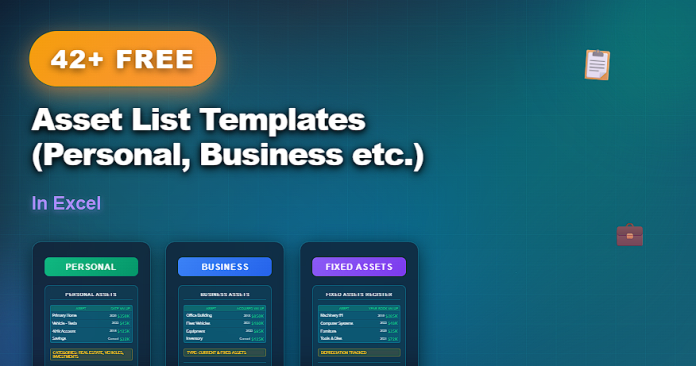
This article presents 42+ free asset list templates, designed specifically for Excel, suitable for personal use, businesses, nonprofits, and institutions.
What Is an Asset List Template?
An asset list template is a structured inventory document used to record and monitor assets owned by an individual or organization.
A standard asset list template typically includes:
- Asset name or description
- Asset category or type
- Purchase date
- Purchase or current value
- Location
- Owner or department
- Condition and notes
Excel templates allow easy updates and automatic organization.
Why Use Free Asset List Templates in Excel?
Using free asset list templates in Excel offers several important benefits.
Key advantages include:
- Centralized asset documentation
- Improved financial and operational visibility
- Easier audits and reporting
- Better asset control and accountability
- Automatic sorting and filtering
Excel provides flexibility without complexity.
42+ Free Asset List Templates (Excel)
Below is a curated collection of free asset list templates, organized by use case and level of detail.
Personal Asset List Templates (1–12)
- Personal Asset Inventory Template
- Household Asset List
- Home Asset Tracking Spreadsheet
- Personal Property Inventory
- Asset List for Insurance Purposes
- Valuables Inventory Template
- Personal Net Worth Asset List
- Asset List with Photos Reference
- Home Contents Inventory
- Personal Asset Register
- Editable Personal Asset List (Excel)
- Simple Personal Asset List
Business Asset List Templates (13–28)
- Business Asset Inventory Template
- Fixed Asset Register (Excel)
- Office Equipment Asset List
- IT Asset Inventory Spreadsheet
- Company Asset Tracking Template
- Asset Register with Serial Numbers
- Asset List with Purchase and Warranty Dates
- Asset Tracking by Department
- Asset List with Assigned Employees
- Small Business Asset Register
- Asset List with Maintenance Records
- Asset Inventory with Depreciation
- Asset Tracking Spreadsheet for Accounting
- Asset List for Audits
- Business Asset Register with Locations
- Comprehensive Business Asset List
Specialized and Advanced Asset List Templates (29–42+)
- Fixed Asset Depreciation Schedule
- Asset List with Replacement Value
- Asset Inventory for Nonprofits
- Asset List for Schools and Institutions
- Asset Register for Warehouses
- Asset List with Barcode Reference
- Asset Tracking Dashboard (Excel)
- Asset List with Condition Ratings
- Asset Inventory for Insurance Claims
- Asset Tracking Spreadsheet with Charts
- Asset List with Lifecycle Status
- Asset Inventory for Project Equipment
- Asset Control Register
- Complete Asset List Template Pack
Why Use Excel for Asset Lists?
Excel is the preferred format for asset tracking due to its flexibility and analytical capabilities.
Benefits of Excel asset list templates include:
- Easy updates and customization
- Sorting and filtering by category or location
- Automatic calculations for totals and depreciation
- Compatibility with accounting systems
- Scalable for growing asset inventories
Excel supports both simple and advanced asset management needs.
Best Practices for Maintaining an Asset List
To keep asset records accurate:
- Update the list regularly
- Assign responsibility for asset tracking
- Record changes immediately
- Store backup copies securely
- Review asset values periodically
Consistent maintenance ensures data reliability.
Common Mistakes to Avoid
When managing asset lists, avoid:
- Incomplete asset descriptions
- Ignoring asset depreciation
- Failing to update asset status
- Mixing personal and business assets
- Losing historical records
Avoiding these mistakes improves asset visibility and control.
Frequently Asked Questions
Are these asset list templates editable?
Yes. All templates are fully editable in Excel.
Can these templates track depreciation?
Yes. Several templates include depreciation fields and calculations.
Are these suitable for businesses and individuals?
Yes. Templates cover both personal and business use cases.
How often should asset lists be updated?
Whenever assets are added, removed, or reassessed.
Conclusion
Accurate asset tracking is essential for financial management, risk control, and operational efficiency. The 42+ free asset list templates in this guide provide professional, flexible tools for documenting and managing assets across personal and business environments.
With templates designed exclusively for Excel, users gain clarity, automation, and control—ensuring assets are properly recorded, valued, and managed over time.

