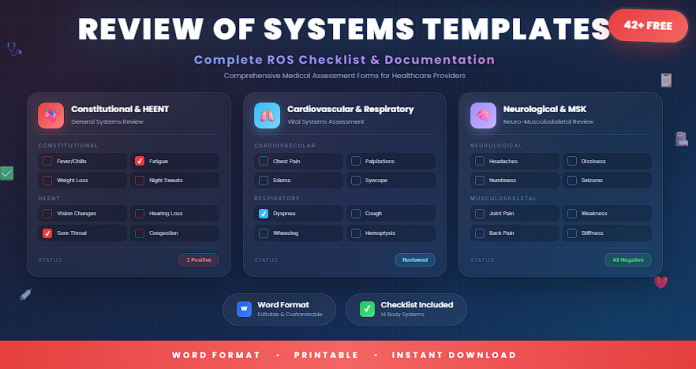

The Review of Systems (ROS) is a critical component of medical documentation and patient assessment. It provides a systematic way to identify symptoms across all major body systems, helping clinicians uncover relevant clinical information that may not emerge during a focused history alone.
Without a structured approach, ROS documentation can become inconsistent or incomplete. Free Review of Systems templates in Word, including checklist formats, offer a standardized solution that improves clarity, efficiency, and clinical accuracy.
This article presents 42+ free Review of Systems templates and checklists, available in Word format, suitable for physicians, nurses, physician assistants, medical students, and healthcare organizations.
What Is a Review of Systems (ROS)?
A Review of Systems is a systematic, head-to-toe inquiry into a patient’s symptoms, organized by body system.
A standard ROS typically covers:
- Constitutional symptoms
- Eyes, ears, nose, and throat
- Cardiovascular system
- Respiratory system
- Gastrointestinal system
- Genitourinary system
- Musculoskeletal system
- Neurological system
- Psychiatric symptoms
- Endocrine, hematologic, and integumentary systems
ROS supports diagnostic reasoning and clinical decision-making.
Why Use Free Review of Systems Templates?
Using free Review of Systems templates provides several key benefits.
Key advantages include:
- Standardized symptom documentation
- Reduced risk of missed clinical information
- Faster and more efficient patient evaluations
- Improved communication between care providers
- Support for medical training and audits
Templates help ensure a thorough and consistent review.
42+ Free Review of Systems Templates (+Checklist – Word)
Below is a curated collection of free ROS templates, organized by format and clinical use.
General and Comprehensive ROS Templates (1–15)
- Comprehensive Review of Systems Template
- General ROS Documentation Form
- Editable Review of Systems (Word)
- Full Body Systems Review Template
- Standard Medical ROS Form
- ROS with Yes/No Checklist
- Review of Systems with Notes Section
- Printable ROS Template
- Adult Review of Systems Form
- Simple Review of Systems Template
- ROS with Patient History Integration
- Review of Systems Intake Form
- Clinical ROS Documentation Template
- Clean and Professional ROS Layout
- Starter Review of Systems Template
Checklist-Based Review of Systems Templates (16–30)
- Review of Systems Checklist (Word)
- ROS Yes/No Symptom Checklist
- Body Systems Review Checklist
- ROS with Symptom Severity Checkboxes
- Review of Systems for Primary Care
- Nursing Review of Systems Checklist
- ROS Checklist for Outpatient Visits
- Emergency Department ROS Checklist
- Pre-Visit Review of Systems Form
- ROS with Frequency and Duration Fields
- Review of Systems with Comment Fields
- Structured ROS Checkbox Template
- Clinical Symptom Screening Checklist
- ROS Checklist with Red Flag Indicators
- Professional ROS Checklist Template
Specialized and Educational ROS Templates (31–42+)
- Pediatric Review of Systems Template
- Geriatric Review of Systems Form
- Mental Health ROS Template
- Cardiovascular-Focused ROS
- Respiratory Review of Systems
- Gastrointestinal ROS Template
- Neurological Review of Systems
- Musculoskeletal ROS Form
- ROS Template for Medical Students
- Teaching and Training ROS Template
- ROS with Documentation Guidelines
- Complete Review of Systems Template Pack
Why Use Word Format for Review of Systems Templates?
Word is widely preferred for ROS documentation due to flexibility and ease of customization.
Benefits of Word ROS templates include:
- Fully editable checklist items
- Easy adaptation for different specialties
- Simple printing and digital storage
- Compatibility with EHR workflows
- Clear, professional formatting
Word templates support both clinical practice and education.
Best Practices for Completing a Review of Systems
To ensure accurate ROS documentation:
- Ask questions systematically by system
- Clarify positive findings with details
- Avoid copying previous ROS entries
- Document both positives and negatives
- Update ROS at appropriate intervals
A thorough ROS strengthens diagnostic accuracy.
Common Mistakes to Avoid
When completing a Review of Systems, avoid:
- Rushing through checklist items
- Marking all systems as “negative” without confirmation
- Omitting follow-up on positive symptoms
- Using vague or non-specific language
- Failing to update ROS at follow-up visits
Avoiding these mistakes improves clinical reliability.
Frequently Asked Questions
Is the Review of Systems required in medical documentation?
While requirements vary, ROS is a standard component of comprehensive medical evaluations.
Are ROS templates suitable for different specialties?
Yes. Templates can be adapted for primary care, specialties, nursing, and education.
Are these ROS templates editable?
Yes. All templates are fully editable in Word.
Can ROS templates be used by students?
Yes. Many templates are designed for learning and clinical training.
Conclusion
The Review of Systems is a vital tool for comprehensive patient assessment and accurate diagnosis. The 42+ free Review of Systems templates and checklists in this guide provide structured, professional tools for documenting symptoms clearly and consistently.With templates available in Word format, healthcare professionals and students can streamline evaluations, improve documentation quality, and support safer, more informed clinical decisions.

 templates and checklists in Word to document patient symptoms clearly, improve clinical assessments, and support accurate diagnoses.)