
Non-disclosure agreements (NDAs) are essential whenever sensitive business information is shared. From product roadmaps and pricing models to source code, client lists, marketing strategies, financial data, and internal processes—confidential information can lose value quickly if it’s exposed, copied, or used without permission.
Without a written NDA, disputes often arise around what counts as confidential, how it can be used, who can access it, how long confidentiality lasts, and what happens after the relationship ends. That’s why free non disclosure agreement templates (NDA forms) in Word are valuable: they provide structured, editable documents that help businesses define confidentiality rules clearly and protect both sides.
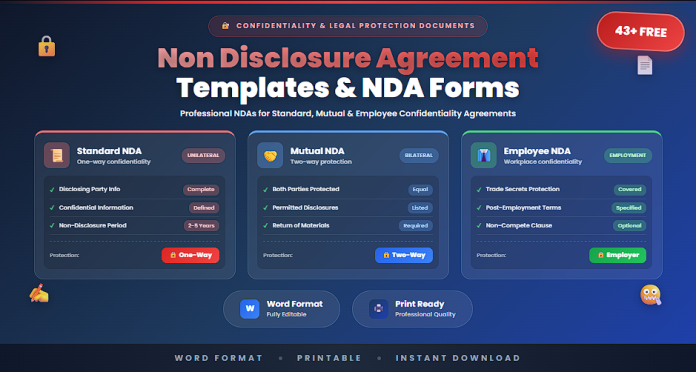
This guide includes 43+ free NDA templates suitable for startups, agencies, freelancers, employees, contractors, vendors, investors (early discussions), and partnerships.
What Is a Non-Disclosure Agreement?
A non-disclosure agreement (NDA) is a legal contract that restricts a recipient from disclosing or misusing confidential information shared by the disclosing party.
A standard NDA typically includes:
✅ Parties and purpose of disclosure
✅ Definition of confidential information
✅ Exclusions (public info, independently developed, already known)
✅ Permitted use (what the recipient may do with the info)
✅ Non-disclosure and non-use obligations
✅ Safeguards (reasonable security measures)
✅ Authorized disclosures (employees/advisors under obligations)
✅ Term and survival (how long obligations last)
✅ Return/destruction of confidential materials
✅ Ownership and IP reservation
✅ Remedies and injunctive relief language (basic)
✅ Dispute resolution and governing law
✅ Signature blocks and attachments
A strong NDA makes confidentiality enforceable and easy to manage.
Why Use Free NDA Templates?
Templates help you protect sensitive information quickly and consistently.
✅ Clear definition of what is confidential
✅ Reduced risk of leaks and misuse
✅ Faster onboarding for partners, vendors, and contractors
✅ Standardized contract language across the business
✅ Clear return/destruction requirements after termination
✅ Better legal readiness if disputes happen
NDAs are especially important before sharing proposals, demos, or internal documents.
43+ Free Non Disclosure Agreement Templates (NDA Forms) (Word)
Below is a curated collection of NDA templates, grouped by NDA type and common business scenarios.
Core NDA Templates (1–16)
✅ Standard Non-Disclosure Agreement Template
✅ Simple NDA (Basic)
✅ One-Page NDA Template
✅ NDA Form (Editable Word)
✅ Mutual NDA Template (Two-Way)
✅ Unilateral NDA Template (One-Way)
✅ NDA with Purpose-Limited Use Clause Template
✅ NDA with Confidential Information Definition Checklist
✅ NDA with Exclusions Section (Public/Independently Developed)
✅ NDA with Return/Destruction Clause Template
✅ NDA Cover Page Template
✅ NDA Review Checklist
✅ NDA Execution Checklist (Pre-Sign)
✅ NDA Amendment Template
✅ Confidentiality Acknowledgment Receipt Template
✅ NDA Termination Notice Template (Basic)
Business, Client, Vendor, and Contractor NDA Templates (17–30)
✅ Client NDA Template (Agency/Consulting)
✅ Vendor/Supplier NDA Template
✅ Independent Contractor NDA Template
✅ Freelancer NDA Template
✅ Employee Confidentiality Agreement (Standalone)
✅ Internship NDA Template (Basic)
✅ Service Provider NDA + Data Access Addendum (Basic)
✅ NDA for Product Demo and Trial Access Template
✅ NDA for RFP / Proposal Sharing Template
✅ NDA for Joint Venture Discussions (Basic)
✅ NDA for Partnership Discussions Template
✅ NDA for Outsourcing / Offshore Team Template (Basic)
✅ NDA for Manufacturing / Prototyping (Basic)
✅ NDA for Marketing Agencies and Media Buyers Template
IP, Data, and Specialized NDA Templates (31–43+)
✅ Software Development NDA Template
✅ Source Code Confidentiality Addendum (Basic)
✅ Intellectual Property Confidentiality Addendum
✅ Trade Secrets NDA Template (Basic)
✅ Customer List Confidentiality NDA Template
✅ Pricing and Financial Information NDA Template
✅ Data Protection and Privacy NDA Addendum (Basic)
✅ HIPAA-Style Confidentiality Addendum (Basic)
✅ Non-Solicitation Addendum (Where Appropriate)
✅ Non-Compete Addendum (Where Appropriate)
✅ Injunctive Relief / Remedies Addendum (Basic)
✅ Dispute Resolution / Arbitration Addendum
✅ Return of Property + Access Revocation Checklist Template
✅ Complete NDA Forms Pack (All-in-One)
✅ Final NDA Negotiation Checklist
Why Use Word Format for NDAs?
NDAs are frequently negotiated—especially definitions, term length, permitted use, and exclusions.
Word format advantages include:
✅ Easy editing of definitions, term, and permitted purpose
✅ Track Changes for negotiation and approvals
✅ Flexible attachments for data access or IP confidentiality
✅ Print-ready signing and professional formatting
✅ Easy PDF export for execution and secure storage
Word is ideal for standardized templates with fast customization.
Best Practices for NDAs
To create stronger NDAs:
✅ Define the “purpose” narrowly (limits misuse)
✅ Use clear confidential information definitions and examples
✅ Include exclusions to keep the NDA reasonable
✅ Limit who can access the information (need-to-know basis)
✅ Require reasonable security safeguards
✅ Include return/destruction obligations at the end
✅ Clarify term and survival (how long confidentiality continues)
✅ Address IP ownership (no license granted unless stated)
✅ Add non-solicitation only when appropriate and lawful
✅ Ensure signatures are from authorized representatives
Most NDA disputes come from vague definitions and unclear purpose restrictions.
Common Mistakes to Avoid
Avoid these common NDA issues:
✅ Overly broad definition of confidential information without exclusions
✅ No clear purpose restriction (allows broad usage)
✅ Missing return/destruction clause
✅ No term or unclear survival period
✅ Not controlling access to advisors and subcontractors
✅ Confusing mutual vs unilateral structure
✅ Relying on verbal promises instead of signed documents
A good NDA is specific, balanced, and enforceable.
Frequently Asked Questions
What’s the difference between a mutual and unilateral NDA?
A unilateral NDA protects one party’s confidential information. A mutual NDA protects both parties when both share sensitive information.
Do NDAs need to be notarized?
Usually not. Most NDAs rely on signatures only, but practices vary by jurisdiction and organization policy.
How long should an NDA last?
It depends on the information type. Some NDAs have a disclosure term (e.g., 1–2 years) and a confidentiality survival period (e.g., 2–5 years). Trade secrets may require longer protection.
Why use Word templates for NDAs?
Word templates are easy to customize, negotiate with tracked changes, and reuse across partners—then export to PDF for signing.
Can NDAs include non-solicitation or non-compete clauses?
Sometimes, but enforceability depends on local law and the role. Use these clauses carefully and only where appropriate.
Conclusion
NDAs protect business value by preventing unauthorized disclosure and misuse of sensitive information. The 43+ free non disclosure agreement templates (NDA forms) in Word in this guide provide editable formats to define confidential information, permitted use, exclusions, term, and return/destruction requirements consistently.
With the right NDA template, businesses can share information confidently, collaborate faster, and reduce risk—while keeping trust and legal protections in place.

 in Word to protect confidential information, define permitted use, set disclosure limits, include exclusions, and document term, remedies, and return/destruction clauses clearly.)