

Case briefing is one of the fastest ways to understand legal decisions and retain them for class discussions, writing assignments, and exams. But many students struggle because their briefs become too long, too vague, or inconsistent—making it hard to compare cases and extract rules of law.
That’s why free case brief examples and templates in Word are helpful. These templates provide structured formats to capture the essential parts of a case—facts, procedural history, issue, rule, holding, reasoning, and disposition—so your notes stay organized and easy to review.
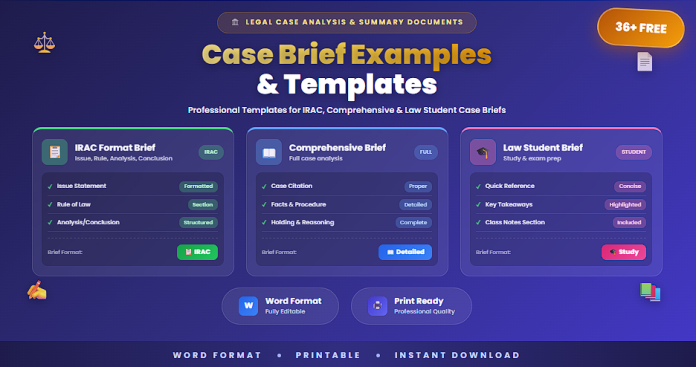
This guide includes 36+ free case brief templates and examples suitable for first-year law courses, advanced classes, bar-style study, and exam prep.
What Is a Case Brief?
A case brief is a structured summary of a judicial opinion. It condenses a case into the key elements you need to understand what happened, what legal question the court answered, and why the court decided the way it did.
A standard case brief usually includes:
- Case name and citation
- Court, jurisdiction, and date
- Key facts (material facts)
- Procedural history (how the case reached the court)
- Issue (legal question)
- Rule of law (legal principle applied)
- Holding (the court’s answer)
- Reasoning / rationale (why the court ruled that way)
- Disposition (result: affirmed, reversed, remanded, etc.)
- Notes / takeaways (how to use it later)
Briefs help you read faster and study smarter.
When Should You Use a Case Brief Template?
Case brief templates are commonly used for:
- Law school reading assignments and class participation
- Building exam outlines and rule statements
- Comparing cases in the same topic area
- Writing memos, research notes, or practice essays
- Preparing for moot court or legal writing courses
- Creating quick review sheets before finals or bar prep
If you want consistent, high-quality case notes, a template keeps everything structured.
36+ Free Case Brief Examples And Templates (Word)
Below is a categorized collection of case brief templates.
Core Case Brief Templates (1–10)
- Standard Case Brief Template (One Page)
- Simple Case Brief Form (Quick Notes)
- Editable Case Brief Template (Word)
- Print-Friendly Case Brief Worksheet
- Case Brief Template with Headings (Facts/Issue/Rule/Holding)
- Case Brief Template with Procedural History Section
- Case Brief Cover Page + Case Index Sheet
- Case Brief Checklist (Before Finalizing)
- Case Brief Template with Key Quotes Section
- Complete Case Brief Templates Bundle
IRAC / CREAC / Legal Analysis Templates (11–20)
- IRAC Case Brief Template (Issue–Rule–Application–Conclusion)
- CREAC Case Brief Template (Conclusion–Rule–Explanation–Application–Conclusion)
- Case Brief Template with Rule Synthesis Section
- Case Brief Template with “Policy Rationale” Notes
- Case Brief Template with Counterarguments Section
- Case Brief Template with “Elements Test” Breakdown
- Case Brief Template with Case-to-Case Comparison Box
- Case Brief Template with Hypothetical Application Section
- Case Brief Template for Statutory Interpretation Cases
- Case Brief Template for Constitutional Law Cases
Appellate and Advanced Case Brief Templates (21–30)
- Appellate Case Brief Template (Expanded)
- Case Brief Template with Standard of Review Section
- Case Brief Template for Multi-Issue Cases
- Case Brief Template for Majority/Dissent Breakdown
- Case Brief Template for Concurrence Notes
- Case Brief Template with Argument Map (Reasoning Tree)
- Case Brief Template with Timeline of Facts
- Case Brief Template with Procedural Posture Flow
- Case Brief Template with “Scope & Limits” Section
- Case Brief Template with “Exam Use” Rule Statement Box
Study, Class, and Exam Prep Templates (31–36+)
- Class-Ready Case Brief Sheet (Cold Call Friendly)
- Case Brief Template with Flashcard Summary Box
- Case Brief Template for Outline Integration (Topic Tags)
- Case Brief Template with Key Terms Glossary Box
- Case Brief Template with “Most Tested Rule” Highlight Section
- Complete Exam-Prep Briefing Pack (All-in-One)
Why Use Word Format for Case Briefs?
Word templates provide flexibility:
✅ Easy editing while reading cases digitally
✅ Consistent headings across all briefs
✅ Add highlighting, comments, and key quotes
✅ Print-ready for class binders
✅ Convert to PDF for clean archival and sharing
Word helps you keep briefs readable and standardized.
Best Practices for Writing Strong Case Briefs
To make case briefs more useful:
✅ Focus on material facts only (facts that change the outcome)
✅ Write the issue as a clear question (“Whether…”)
✅ State the rule as a usable rule statement (not a paragraph)
✅ Summarize reasoning in steps (because → therefore)
✅ Include the disposition (affirmed/reversed/remanded)
✅ Capture one key takeaway for exam use
✅ Keep it short and consistent (one page when possible)
A good brief helps you recall the case in seconds.
Common Mistakes to Avoid
- Copying too many facts or quoting long passages
- Writing the issue too broadly or too vaguely
- Missing procedural posture or court level
- Confusing holding with reasoning
- Writing rules as “what happened” instead of legal principles
- Skipping disposition or the case’s practical impact
Consistency matters more than length.
Frequently Asked Questions
What is the best format for a case brief?
The best format is the one you can repeat consistently. Many students use Facts → Procedural History → Issue → Rule → Holding → Reasoning → Disposition → Takeaway.
Is a case brief the same as an appellate brief?
No. A case brief summarizes a court opinion for study; an appellate brief is an argument submitted to a court.
How long should a case brief be?
Often 1 page is enough, especially for class prep. Complex cases may require 2 pages.
Should I use IRAC or a traditional case brief?
Traditional briefs are better for understanding opinions; IRAC/CREAC helps translate the case into exam-ready analysis.
Why use Word templates?
Word templates make it easy to repeat the same structure, edit quickly, and build a clean library of organized case briefs.
Conclusion
Case brief templates make legal reading more organized and exam prep more effective by turning long opinions into structured, repeatable summaries. The 36+ free case brief examples and templates in Word in this guide provide editable formats for one-page briefs, IRAC/CREAC analysis, advanced appellate case notes, and exam-focused study sheets.
Using a consistent case brief template saves time, improves recall, and helps you extract rules and reasoning you can actually use.