

A pre-approval letter can make a major difference when someone applies for a mortgage or tries to make an offer on a property. Sellers, agents, landlords, and financial professionals often rely on these letters as proof that a borrower has already gone through an initial lender review. But not every letter is reliable. Some are incomplete, some are only basic prequalification notices, and some may be fake or misleading.
That’s why free real pre-approval letter templates in Word are useful—and why it is equally important to understand the warning signs of suspicious or fake letters. A clear, professional template helps organize borrower and lender information correctly, while educational red-flag examples can help readers recognize documents that should be verified before relying on them.
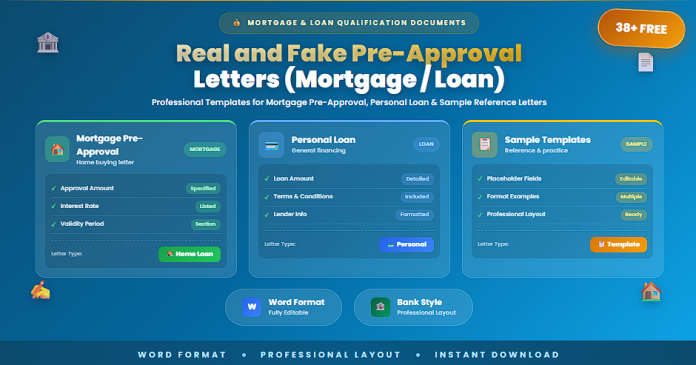
This guide includes 38+ free mortgage and loan pre-approval letter templates, along with educational fake-letter red flags to help you review financing documents more carefully. These “fake” examples are for awareness and verification training only, not for use as real lender documents.
What Is a Pre-Approval Letter?
A pre-approval letter is a document issued by a lender stating that a borrower has gone through an initial financial review and may qualify for financing up to a certain amount, subject to stated conditions.
A standard pre-approval letter usually includes:
- Borrower name
- Lender name and contact details
- Loan officer or representative information
- Estimated approved loan amount
- Loan type or financing program
- Date issued and expiration date
- Key conditions or assumptions
- Signature or lender authorization
A legitimate pre-approval letter is usually specific, professional, and easy to verify.
When Should You Use a Pre-Approval Letter Template?
Pre-approval letter templates are commonly used for:
- Mortgage pre-approval communication
- Home purchase offers
- Financing confirmation for real estate agents
- Borrower file organization
- Internal lender document formatting
- Educational review of financing paperwork
- Learning how to spot suspicious loan documents
If financing proof needs to be presented clearly, a structured template helps.
38+ Free Real and Fake Pre-Approval Letters (for Mortgage / Loan) (Word)
Below is a categorized collection of pre-approval letter templates and educational red-flag examples.
Real Pre-Approval Letter Templates (1–12)
- Standard Mortgage Pre-Approval Letter Template
- Simple Loan Pre-Approval Letter Template
- Editable Pre-Approval Letter (Word)
- Print-Friendly Mortgage Pre-Approval Letter
- Pre-Approval Letter with Loan Amount Section
- Pre-Approval Letter with Expiration Date Field
- Pre-Approval Letter with Borrower Summary Page
- Pre-Approval Letter Cover Page + Checklist
- Pre-Approval Letter with Conditional Review Section
- Financing Verification Letter Template
- Real Estate Offer Support Pre-Approval Letter
- Complete Pre-Approval Letter Templates Bundle
Mortgage and Home Loan Templates (13–24)
- Conventional Mortgage Pre-Approval Letter Template
- FHA Loan Pre-Approval Letter Template (Basic)
- VA Loan Pre-Approval Letter Template (Basic)
- First-Time Homebuyer Pre-Approval Letter
- Home Purchase Financing Letter Template
- Pre-Approval Letter with Down Payment Note
- Pre-Approval Letter with Property Price Range Section
- Borrower Income Review Summary Letter
- Lender Contact Verification Page
- Mortgage Prequalification vs Pre-Approval Comparison Sheet
- Pre-Approval Letter Renewal / Update Template
- Conditional Mortgage Approval Summary Template
Educational Fake-Letter Red-Flag Examples (25–38+)
- Red-Flag Example: Missing Lender Address Layout
- Red-Flag Example: No Loan Officer Signature Sample
- Red-Flag Example: Vague “Guaranteed Approval” Wording
- Red-Flag Example: No Expiration Date Sample
- Red-Flag Example: Inconsistent Borrower Name Format
- Red-Flag Example: No Conditions Listed Template
- Red-Flag Example: Suspicious Contact Information Layout
- Red-Flag Example: No NMLS / Licensing Reference Area (If Applicable)
- Red-Flag Example: Poor Formatting and Generic Branding Sample
- Red-Flag Example: Unrealistic Loan Amount Language
- Red-Flag Example: No Verification Instructions Sample
- Red-Flag Example: Altered Date / Amount Layout
- Red-Flag Checklist for Reviewing Pre-Approval Letters
- Verification Request Form for Agents / Sellers
Why Use Word Format for Pre-Approval Letters?
Word templates provide flexibility:
✅ Easy editing of borrower names, dates, and loan amounts
✅ Professional formatting for lender-style communication
✅ Add conditions, expiration dates, and contact sections clearly
✅ Convert to PDF for sharing and recordkeeping
✅ Useful for both training and document organization
Word helps keep financing letters clean and professional.
Best Practices for Reviewing Pre-Approval Letters
To review pre-approval letters more carefully:
✅ Confirm the lender name and contact information
✅ Check that the borrower’s name matches exactly
✅ Look for a specific loan amount or price range
✅ Verify the date issued and expiration date
✅ Review whether conditions are clearly stated
✅ Confirm there is a real loan officer or contact person
✅ Contact the lender directly if verification is needed
✅ Be cautious of vague “guaranteed approval” language
A real letter should be clear, specific, and verifiable.
Common Mistakes to Avoid
- Treating a prequalification as a full pre-approval
- Relying on a letter without verifying the lender
- Ignoring missing contact information
- Overlooking inconsistent names or dates
- Accepting unrealistic “fully guaranteed” wording
- Using generic templates as if they were real lender-issued documents
Financing documents should always be reviewed carefully before they are trusted.
Frequently Asked Questions
What is the difference between prequalification and pre-approval?
Prequalification is often a lighter, early estimate, while pre-approval usually reflects a more detailed initial review by a lender.
Can a pre-approval letter be fake?
Yes. Some documents may be altered, misleading, or entirely fabricated, which is why lender verification is important.
What are the biggest red flags in a suspicious pre-approval letter?
Missing lender details, no signature, vague guarantees, inconsistent borrower information, and no clear verification path are common warning signs.
Should real estate agents or sellers verify a pre-approval letter?
Yes. Verifying directly with the lender is one of the safest ways to confirm authenticity.
Why use Word templates?
Word templates are useful for organizing real lender-style formats and for training teams to recognize professional structure and suspicious document red flags.
Conclusion
Pre-approval letters are important financing documents, especially in mortgage and home purchase situations. The 38+ free real pre-approval letter templates in Word in this guide help organize lender-style communication clearly, while the educational red-flag examples help readers recognize suspicious or fake documents more effectively.
Using a clear template—and verifying any real lender letter before relying on it—improves accuracy, reduces risk, and helps financing decisions move forward with more confidence.