

Understanding family relationships, emotional dynamics, and generational patterns can provide valuable insight into personal history and social behavior. In fields such as psychology, social work, counseling, and healthcare, professionals often use visual tools to analyze family structures and relationships across multiple generations.
One of the most commonly used tools for this purpose is the genogram. Unlike a simple family tree, a genogram includes additional information such as emotional relationships, behavioral patterns, and medical history. This makes it a powerful tool for therapists, researchers, healthcare professionals, and educators.
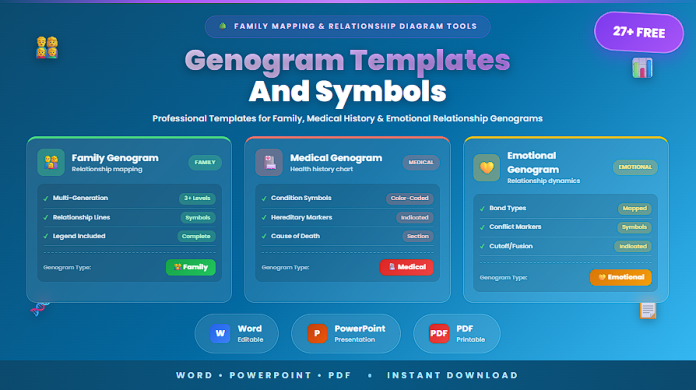
Using free genogram templates and symbols in Word, PowerPoint, and PDF makes it easier to create structured diagrams that represent family relationships and generational patterns. These templates provide organized visual layouts that help users map complex family connections clearly.
In this guide, you will find 27+ free genogram templates designed for family history mapping, psychological analysis, medical documentation, and counseling assessments.
What Is a Genogram?
A genogram is a visual diagram that maps family relationships and patterns across multiple generations. It is similar to a family tree but includes additional information about relationships, emotional connections, and health history.
Genograms are widely used in various professional fields to analyze family dynamics and identify patterns that may affect individuals or families.
A typical genogram may include:
• Family member names and basic information
• Generational connections and lineage
• Marriage, divorce, and relationship indicators
• Emotional relationship patterns
• Health conditions or hereditary diseases
• Behavioral or psychological patterns
These diagrams help professionals understand how family relationships influence behavior, health, and personal development.
When Should You Use a Genogram Template?
Genogram templates can be used in many personal and professional situations.
They are commonly used for:
• Family therapy and counseling assessments
• Medical history documentation
• Social work family evaluations
• Psychological research and analysis
• Genealogy and family history research
• Educational projects about family structures
Using a structured template helps ensure the diagram clearly represents relationships and family history.
27+ Free Genogram Templates And Symbols (Word, PowerPoint, PDF)
Below is a categorized collection of genogram templates designed for different purposes.
Basic Family Genogram Templates (1–8)
• Standard Family Genogram Template
• Simple Family Relationship Genogram
• Editable Genogram Template (Word)
• Printable Family Genogram Template (PDF)
• Three-Generation Family Genogram
• Basic Family Structure Diagram
• Family Tree Genogram Template
• Multi-Generation Family Chart
Medical and Health Genogram Templates (9–16)
• Medical History Genogram Template
• Family Health History Genogram
• Genetic Condition Tracking Genogram
• Hereditary Disease Mapping Genogram
• Health Risk Assessment Genogram
• Medical Family Tree Diagram
• Healthcare Counseling Genogram
• Clinical Family Health Genogram
Counseling and Psychology Genogram Templates (17–22)
• Therapy Family Relationship Genogram
• Emotional Relationship Genogram Template
• Counseling Family Dynamics Diagram
• Psychological Family Mapping Template
• Social Work Genogram Template
• Behavioral Pattern Genogram
Presentation and Advanced Genogram Templates (23–27+)
• PowerPoint Genogram Template
• Professional Counseling Genogram Presentation
• Family Relationship Diagram Template
• Detailed Multi-Generation Genogram
• Complete Genogram Template and Symbol Pack
Common Genogram Symbols
Genograms use standardized symbols to represent different family members and relationships.
Some commonly used genogram symbols include:
• Square symbol representing a male family member
• Circle symbol representing a female family member
• Horizontal line indicating marriage or partnership
• Diagonal line indicating divorce or separation
• Vertical lines connecting parents and children
• Dashed lines representing emotional relationships
• Additional symbols indicating health conditions
Using standardized symbols helps make genograms easier to understand and interpret.
Why Use Word, PowerPoint, and PDF Templates?
Using multiple file formats provides flexibility when creating genograms.
Word templates allow users to easily edit text and modify family information within the diagram.
PowerPoint templates are useful for creating visual presentations or teaching materials related to family relationships and counseling analysis.
PDF templates provide ready-to-print genogram diagrams that can be used in documentation or educational activities.
Benefits of these formats include:
• Easy editing and customization
• Professional visual layouts
• Printable diagrams for documentation
• Reusable templates for multiple projects
• Clear visual representation of family relationships
These templates make it easier to create and share genograms.
Best Practices for Creating a Genogram
When creating a genogram, several best practices can help ensure the diagram is clear and informative.
Recommended practices include:
• Include at least three generations of family members
• Use standardized genogram symbols consistently
• Clearly label family relationships and connections
• Document relevant medical or behavioral information
• Keep the diagram organized and easy to read
• Update the genogram when new information becomes available
Following these practices helps ensure the genogram accurately represents family dynamics.
Common Mistakes to Avoid
Some mistakes can make genograms difficult to interpret.
Common issues include:
• Using inconsistent symbols or labels
• Including too many details that clutter the diagram
• Not indicating generational connections clearly
• Omitting important family members
• Failing to document relevant medical history
• Creating diagrams that are difficult to read
Avoiding these mistakes helps ensure the genogram is clear and useful.
Frequently Asked Questions
What is a genogram used for?
A genogram is used to visualize family relationships, generational patterns, and medical or behavioral history.
How is a genogram different from a family tree?
A genogram includes additional information such as emotional relationships, health history, and behavioral patterns.
Who uses genograms professionally?
Psychologists, social workers, therapists, healthcare professionals, and researchers commonly use genograms.
Can genogram templates be edited?
Yes. Word and PowerPoint templates can be customized to include family information and relationship details.
Why are genogram symbols important?
Symbols help standardize the diagram and make it easier to understand complex family relationships.
Conclusion
Genograms are powerful tools for visualizing family relationships, emotional connections, and generational patterns. They are widely used in counseling, healthcare, social work, and genealogy research to understand family structures and behavioral influences.
The 27+ free genogram templates and symbols in Word, PowerPoint, and PDF included in this guide provide structured diagrams for mapping family relationships, documenting health history, and analyzing family dynamics.
Using these templates helps professionals and individuals create clear visual representations of family systems while maintaining organized and meaningful documentation.