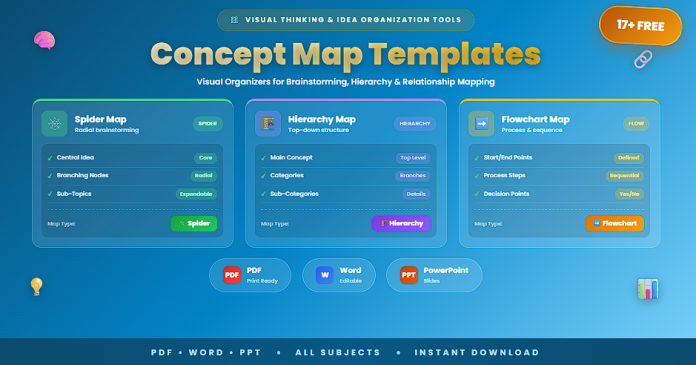


Concept maps are powerful visual learning tools used to organize ideas, connect related concepts, and simplify complex information. They help learners understand relationships between topics by presenting information in a structured diagram that links concepts together.
Teachers, students, and professionals use concept maps to clarify ideas, plan projects, and improve knowledge retention. These diagrams make it easier to visualize how information is connected, which supports deeper understanding and better problem-solving.
Concept maps are commonly used in education, research, project planning, and brainstorming activities. They allow users to break down large topics into smaller concepts and show how each idea relates to others.
Using free concept map templates in PDF, Word, and PPT makes it easy to create clear visual diagrams for organizing knowledge, planning lessons, and mapping complex ideas.
In this guide, you will find 17+ concept map templates designed for education, brainstorming, learning activities, and knowledge visualization.
What Is a Concept Map?
A concept map is a visual diagram used to represent relationships between different ideas or concepts. It typically starts with a central idea and branches out into related concepts connected by lines or arrows.
Concept maps help users structure information in a logical and easy-to-understand format.
A typical concept map includes:
• A central topic or main idea
• Related concepts connected to the main idea
• Linking words that describe relationships
• Branches that organize information hierarchically
This structure helps learners visualize connections between ideas.
When Should Concept Map Templates Be Used?
Concept map templates are useful whenever people need to organize ideas or visualize relationships between topics.
They are commonly used for:
• Classroom learning activities
• Lesson planning and study guides
• Brainstorming sessions
• Research topic organization
• Project planning
• Knowledge management
Concept maps help simplify complex ideas and improve understanding.
17+ Free Concept Map Templates (PDF, Word And PPT)
Below is a categorized collection of concept map templates for different uses.
Basic Concept Map Templates (1–6)
• Simple Concept Map Template
• Basic Concept Relationship Diagram
• Printable Concept Mapping Worksheet
• Standard Concept Organizer Template
• Beginner Concept Map Diagram
• Simple Knowledge Mapping Template
Educational Concept Map Templates (7–12)
• Classroom Concept Mapping Worksheet
• Student Study Concept Map Template
• Learning Concept Organizer Diagram
• Lesson Planning Concept Map
• Knowledge Structure Concept Map
• Visual Learning Concept Mapping Template
Advanced Concept Map Templates (13–17+)
• Hierarchical Concept Map Template
• Complex Idea Mapping Diagram
• Detailed Concept Relationship Chart
• Multi-Level Concept Map Template
• Comprehensive Concept Mapping Template Pack
Key Elements of a Concept Map
Concept maps include several elements that help represent relationships between ideas clearly.
Important elements typically include:
Central Concept
The main idea placed at the center of the diagram.
Related Concepts
Supporting ideas connected to the main concept.
Linking Words
Words or phrases that explain relationships between concepts.
Branches
Lines that connect concepts and organize them into hierarchical structures.
These elements help create meaningful connections between ideas.
Why Use PDF, Word, and PPT Concept Map Templates?
Using multiple formats allows users to create concept maps in different environments.
Word advantages
• Easy editing and customization
• Printable diagrams for classroom activities
• Flexible formatting options
PDF advantages
• Clean printable worksheets
• Easy sharing and distribution
• Consistent formatting
PowerPoint advantages
• Ideal for presentations and visual explanations
• Interactive learning opportunities
• Easy integration into classroom lessons
These formats allow teachers and professionals to use concept maps in multiple ways.
Best Practices for Creating Concept Maps
Concept maps are most effective when they are designed clearly and logically.
Recommended practices include:
• Start with a clear central idea
• Organize related concepts logically
• Use short linking words to explain relationships
• Avoid overcrowding the diagram with too many ideas
• Use colors or shapes to highlight important concepts
These strategies help improve clarity and understanding.
Common Mistakes to Avoid
Some mistakes can reduce the effectiveness of concept maps.
Common issues include:
• Using unclear relationships between concepts
• Overloading the diagram with too many ideas
• Not organizing concepts hierarchically
• Ignoring linking words that explain relationships
Keeping concept maps simple and structured improves their usefulness.
Frequently Asked Questions
What is a concept map used for?
A concept map is used to visually organize ideas and show relationships between concepts.
Who uses concept map templates?
Teachers, students, researchers, and professionals commonly use them.
Are concept maps helpful for studying?
Yes. They improve memory and help learners understand complex topics.
Can concept maps be used for brainstorming?
Yes. They are excellent tools for brainstorming and organizing ideas.
Why are concept maps effective learning tools?
They help learners visualize relationships between ideas and improve comprehension.
Conclusion
Concept maps are valuable visual tools for organizing knowledge, exploring relationships between ideas, and simplifying complex information. They help learners and professionals understand topics more clearly by presenting information in a structured diagram.
The 17+ free concept map templates in PDF, Word, and PPT included in this guide provide practical resources for education, brainstorming, research, and project planning.
Using these templates helps users organize ideas effectively while improving understanding, creativity, and learning outcomes.