Successful collaborations require more than good intentions. Whether two businesses are co-developing a product, creators are partnering on content, or organizations are running a joint initiative, a written collaboration agreement helps define how work will be done and how outcomes will be shared.
Without a clear contract, partnerships can face disputes around ownership, responsibilities, deadlines, and revenue allocation. Free collaboration agreements and contract samples in Word provide practical templates to structure cooperation professionally and reduce legal and operational ambiguity.
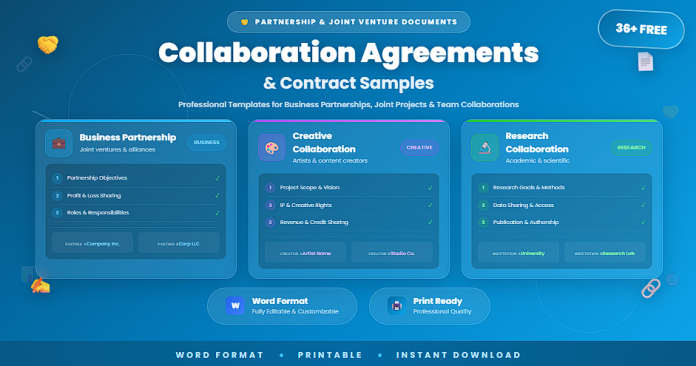
This guide includes 36+ free collaboration agreement templates and contract samples for business, creative, marketing, research, and project-based partnerships.
What Is a Collaboration Agreement?
A collaboration agreement is a formal contract between two or more parties working together on a shared initiative, project, product, or service.
A standard collaboration contract usually includes:
- Parties and purpose of collaboration
- Scope, deliverables, and milestones
- Roles and responsibilities of each party
- Budget, cost-sharing, or compensation terms
- Intellectual property ownership and usage rights
- Confidentiality and data-sharing terms
- Governance, communication, and approvals
- Term, termination, and dispute resolution clauses
- Signatures and effective date
A strong agreement helps partnerships run smoothly and transparently.
Why Use Free Collaboration Agreements and Contract Samples?
Using free collaboration agreement templates provides practical benefits across planning and execution.
Key benefits include:
- Faster setup of partnership terms
- Clear accountability and role alignment
- Reduced risk of scope and ownership disputes
- Better control of timelines and deliverables
- Editable format for different collaboration models
- Professional documentation for trust and governance
Templates help teams collaborate with clarity from day one.
36+ FREE Collaboration Agreements and Contract Samples (Word)
Below is a curated collection of collaboration agreement templates, grouped by partnership type and contract focus.
Core and General Collaboration Agreement Templates (1–12)
- Standard Collaboration Agreement Template
- Simple Collaboration Contract Sample
- One-Page Collaboration Agreement
- Editable Collaboration Agreement (Word)
- Two-Party Collaboration Contract
- Multi-Party Collaboration Agreement
- Joint Project Collaboration Template
- Strategic Collaboration Agreement
- Co-Operation Framework Contract
- Professional Partnership Agreement
- General Business Collaboration Contract
- Universal Collaboration Contract Starter
Business, Marketing, and Commercial Collaboration Templates (13–24)
- Joint Marketing Collaboration Agreement
- Co-Branding Collaboration Contract
- Business Development Collaboration Template
- Product Co-Creation Agreement
- Service Delivery Collaboration Contract
- Agency-Client Collaboration Agreement
- Vendor Collaboration Contract Sample
- Distribution Collaboration Agreement
- Sales Partnership Collaboration Contract
- Startup Collaboration Agreement
- Technology Partnership Collaboration Template
- Cross-Border Collaboration Contract Sample
Creative, Research, and Governance-Focused Templates (25–36+)
- Content Creator Collaboration Agreement
- Influencer Brand Collaboration Contract
- Design Collaboration Agreement
- Music/Media Collaboration Contract Sample
- Research Collaboration Agreement
- Academic Collaboration Contract
- Nonprofit Program Collaboration Agreement
- Grant-Based Collaboration Contract
- IP Ownership Collaboration Addendum
- Revenue Share Collaboration Agreement
- Confidentiality + Collaboration Combined Contract
- Master Collaboration Agreement + SOW Template
- Complete Collaboration Contract Templates Pack
Why Use Word Format for Collaboration Agreements?
Word is ideal for agreements that require negotiation, edits, and stakeholder feedback.
Word format advantages include:
- Easy clause customization for different partnership models
- Fast redlining and legal review workflow
- Reusable templates across recurring collaborations
- Print-ready format for approval and signatures
- Flexible attachments for deliverables and governance schedules
It supports legal, operational, and commercial teams in one workflow.
Best Practices for Drafting Collaboration Contracts
To build stronger collaboration agreements:
- Define collaboration goals and boundaries clearly
- Assign responsibilities with measurable outputs
- Set realistic timelines and approval checkpoints
- Clarify ownership of jointly created work
- Include confidentiality and data-sharing safeguards
- Document budget, payment, or revenue-share logic transparently
- Establish governance and dispute escalation paths early
Clear agreements protect relationships and execution quality.
Common Mistakes to Avoid
When preparing collaboration contracts, avoid:
- Vague scope definitions
- Missing ownership terms for co-created assets
- Unclear decision-making authority
- No change-control process for evolving scope
- Ignoring termination and exit planning
- Using generic templates without context-specific edits
Partnership success depends on clarity, not assumptions.
Frequently Asked Questions
What is the difference between a collaboration agreement and an MOU?
A collaboration agreement is usually more detailed and contract-oriented, while an MOU often outlines intent at a higher level.
Can collaboration contracts include revenue sharing?
Yes. Many include revenue split, cost-sharing, or performance-based compensation clauses.
Should IP ownership always be addressed?
Yes. IP terms are critical whenever content, products, or processes are co-created.
Why use editable Word templates?
Word templates are easy to customize, review, redline, and reuse across projects.
Can these templates be used for nonprofit and academic collaborations?
Yes. The collection includes templates suitable for nonprofit, research, and educational partnerships.
Conclusion
Clear agreements are the foundation of successful collaboration. The 36+ free collaboration agreements and contract samples in Word in this guide provide practical frameworks to define roles, deliverables, ownership, confidentiality, and governance with confidence.
With the right template, teams can build stronger partnerships, reduce risk, and execute joint initiatives with greater alignment and trust.

