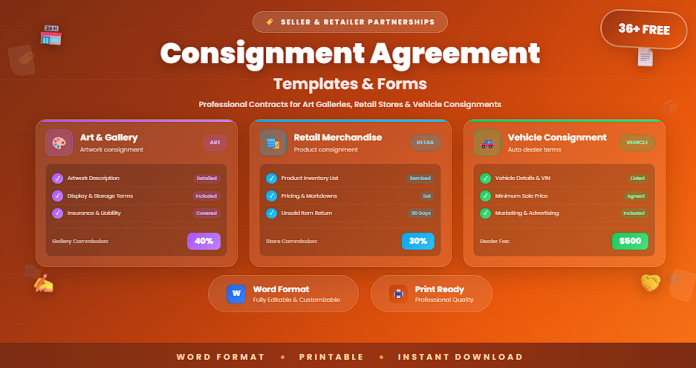

Consignment arrangements help suppliers place goods with retailers or agents without transferring ownership until items are sold. This model supports broader distribution while reducing upfront purchasing pressure on the selling party.
Without a clear written agreement, consignment deals can create disputes over stock tracking, pricing authority, commission rates, damage liability, and unsold inventory returns. Free consignment agreement templates and forms in Word provide practical structures to formalize responsibilities and financial terms clearly.
This guide includes 36+ free consignment agreement templates and forms for retail, fashion, handmade goods, art, furniture, e-commerce, and specialty product partnerships.
What Is a Consignment Agreement?
A consignment agreement is a commercial contract between a consignor (owner/supplier of goods) and a consignee (seller/agent) that defines how goods will be marketed and sold.
A standard consignment agreement typically includes:
- Consignor and consignee details
- Inventory description and quantity records
- Ownership and title retention terms
- Pricing rules and discount permissions
- Commission/fee structure
- Sales reporting and payment schedule
- Storage, care, and risk responsibility
- Return of unsold goods and termination terms
- Signature and effective date sections
A strong agreement protects both inventory and revenue flow.
Why Use Free Consignment Agreement Templates and Forms?
Using free consignment agreement templates provides practical legal and operational advantages.
Key benefits include:
- Clear ownership and sales responsibility boundaries
- Better inventory tracking and accountability
- Transparent commission and payout calculations
- Reduced disputes over pricing and markdowns
- Faster setup of supplier-retailer partnerships
- Editable format for different products and channels
Templates help consignment programs run consistently and professionally.
36+ Free Consignment Agreement Templates and Forms (Word)
Below is a curated collection of consignment agreement templates, grouped by use case and contract focus.
Core and General Consignment Agreement Templates (1–12)
- Standard Consignment Agreement Template
- Simple Consignment Contract Form
- One-Page Consignment Agreement
- Editable Consignment Agreement (Word)
- General Consignor-Consignee Contract
- Product Consignment Terms Template
- Retail Consignment Agreement Form
- Resale Consignment Contract
- Basic Inventory Consignment Agreement
- Consignment Partnership Starter Template
- Printable Consignment Form
- Universal Consignment Agreement Template
Product and Industry-Specific Consignment Templates (13–24)
- Clothing/Fashion Consignment Agreement
- Jewelry Consignment Contract
- Art Gallery Consignment Agreement
- Handmade Products Consignment Form
- Furniture Consignment Agreement
- Antiques Consignment Contract
- Bookstore Consignment Agreement
- Gift Shop Consignment Form
- Beauty Product Consignment Agreement
- Electronics Consignment Contract
- Food/Specialty Product Consignment Template
- E-commerce Consignment Agreement
Commission, Reporting, and Risk-Focused Templates (25–36+)
- Commission-Based Consignment Agreement
- Tiered Commission Consignment Contract
- Monthly Sales Reporting Consignment Form
- Sales Reconciliation and Payout Addendum
- Price Control and Markdown Clause Template
- Inventory Loss/Damage Responsibility Clause
- Insurance and Risk Allocation Addendum
- Unsold Goods Return Policy Agreement
- Minimum Sales Performance Clause Template
- Multi-Location Consignment Contract
- Termination and Final Settlement Consignment Form
- Complete Consignment Agreement Templates Pack
- Consignment Audit and Stock Check Checklist
Why Use Word Format for Consignment Agreements?
Word is ideal for consignment documents because inventory, commissions, and product terms often require frequent updates.
Word format advantages include:
- Easy editing for product lists and pricing rules
- Fast customization for different retailers/channels
- Simple legal review and clause adjustments
- Print-ready format for signatures and records
- Reusable templates for recurring consignments
It supports both operational flexibility and contractual clarity.
Best Practices for Consignment Agreements
To create stronger consignment contracts:
- List inventory items with clear identifiers/SKUs
- Define who controls final selling price and discounts
- Set sales reporting frequency and payout dates
- Clarify storage standards and damage responsibility
- Include audit rights for stock verification
- Establish unsold inventory return deadlines and conditions
- Document termination process and final account settlement
Clear inventory and payment terms are central to successful consignment.
Common Mistakes to Avoid
When preparing consignment agreements, avoid:
- Missing ownership/title retention language
- Unclear commission calculation method
- No process for stock reconciliation
- Undefined liability for lost or damaged items
- Vague return terms for unsold inventory
- Verbal pricing changes without written approval
Strong documentation reduces financial leakage and partnership friction.
Frequently Asked Questions
Who owns goods in a consignment arrangement?
The consignor usually retains ownership until goods are sold to end customers.
How is the consignee paid?
Typically through a commission or agreed percentage of each sale.
Should unsold inventory return terms be included?
Yes. Return timing and condition requirements should be clearly documented.
Why use editable Word templates for consignment agreements?
Word templates are easy to customize for inventory details, commission rules, and partner-specific terms.
Can consignment agreements be used for online sales channels?
Yes. Templates can be adapted for e-commerce and multi-channel resale arrangements.
Conclusion
A clear consignment agreement is essential for protecting stock, revenue, and partner relationships. The 36+ free consignment agreement templates and forms in Word in this guide provide practical frameworks for ownership terms, inventory controls, commission logic, and payout governance.
With the right template, consignors and consignees can collaborate more confidently, reduce disputes, and scale consignment operations with better structure.

