
Data privacy obligations now affect nearly every business relationship involving customer, employee, or user information. A Data Processing Agreement (DPA) helps organizations define how personal data is processed, protected, transferred, and governed between parties.
Without a written DPA, responsibilities can become unclear—especially around security controls, breach response, subprocessors, and data subject rights. Free simple DPA agreements and contracts in Word provide practical, editable templates that help teams document privacy obligations clearly and consistently.
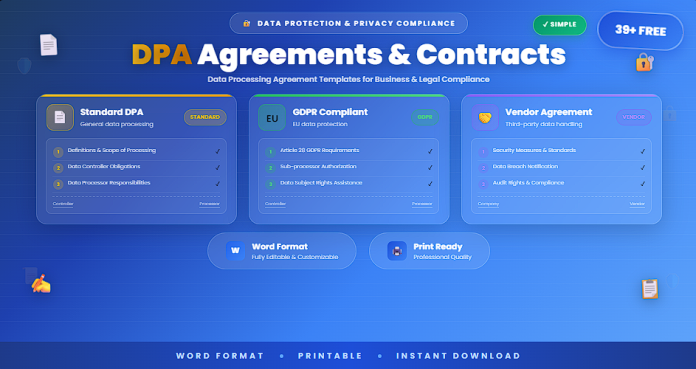
This guide includes 39+ free simple DPA agreement templates for vendors, service providers, SaaS partnerships, agencies, HR tools, and internal compliance workflows.
What Is a DPA Agreement?
A DPA (Data Processing Agreement) is a contractual document that defines how one party processes personal data on behalf of another party.
A standard DPA typically includes:
- Parties and role definitions (Controller/Processor)
- Processing purpose and scope
- Data categories and data subject types
- Confidentiality and security obligations
- Subprocessor authorization terms
- Breach notification requirements
- Data transfer and cross-border clauses
- Data return/deletion terms at contract end
- Audit, compliance, and liability provisions
A clear DPA reduces legal risk and improves compliance readiness.
Why Use Free Simple DPA Agreements and Contracts?
Using free simple DPA templates provides important operational and legal benefits.
Key benefits include:
- Faster contract drafting and negotiation
- Clear data protection responsibilities
- Better consistency across vendor agreements
- Easier legal/compliance review workflows
- Editable format for industry-specific use cases
- Improved readiness for privacy audits and due diligence
Templates help teams move faster while maintaining structure and clarity.
39+ Free Simple DPA Agreements and Contracts (Word)
Below is a curated collection of DPA templates, grouped by business use case and contract structure.
Core and General DPA Agreement Templates (1–12)
- Simple Data Processing Agreement Template
- Standard Controller-Processor DPA
- Basic Personal Data Processing Contract
- One-Page DPA Summary Agreement
- Editable DPA Master Template (Word)
- General Vendor Data Processing Addendum
- Service Provider DPA Template
- Data Handling and Security DPA
- Data Privacy Obligations Agreement
- Minimal Compliance DPA Format
- Universal DPA Contract Template
- Plain-Language DPA Agreement
Vendor, SaaS, and Service-Based DPA Templates (13–25)
- SaaS Provider DPA Template
- Cloud Services DPA Agreement
- Marketing Agency Data Processing Agreement
- CRM Platform DPA Template
- Email/Communication Tool DPA Contract
- HR Software DPA Agreement
- Payroll Processor DPA Template
- IT Support Services DPA
- Analytics Provider DPA Template
- Customer Support Platform DPA
- E-commerce Vendor DPA Agreement
- Outsourcing Partner DPA Contract
- Third-Party Data Access DPA Template
Compliance, Security, and Transfer-Focused DPA Templates (26–39+)
- Subprocessor Authorization DPA Addendum
- Cross-Border Data Transfer DPA Clause Pack
- Data Breach Notification DPA Template
- Security Controls and Measures DPA
- Data Retention and Deletion DPA Agreement
- Data Subject Rights Assistance Clause Template
- Audit and Inspection Rights DPA Template
- Incident Response Cooperation DPA Form
- International Data Processing Addendum
- Sensitive Data Processing DPA Template
- Multi-Vendor DPA Register Attachment
- Termination and Data Return DPA Clause
- DPA + Confidentiality Combined Agreement
- Complete DPA Agreement Templates Pack
- DPA Review and Sign-Off Checklist (Word)
Why Use Word Format for DPA Agreements?
Word is a practical format for legal and compliance documents that require negotiation and revision.
Word format advantages include:
- Easy clause editing and legal redlining
- Fast adaptation to vendor and jurisdiction contexts
- Clear structure for legal/compliance collaboration
- Print-ready format for review and signature workflows
- Reusable baseline template for procurement cycles
It is ideal for teams that need editable, trackable contract drafts.
Best Practices for Drafting a Simple DPA
To make DPA templates more effective:
- Clearly define Controller and Processor roles
- Specify processing purpose and lawful scope
- List data categories and subject types precisely
- Include concrete security and breach timelines
- Document subprocessor approval requirements
- Align retention/deletion clauses with contract lifecycle
- Route final drafts through legal/compliance review
Clarity in scope and obligations is essential for enforceable privacy governance.
Common Mistakes to Avoid
When preparing DPA agreements, avoid:
- Using vague security commitments
- Omitting subprocessor and transfer provisions
- Leaving breach notice timing undefined
- Ignoring data return/deletion obligations at termination
- Copy-pasting clauses without context alignment
- Treating DPA as standalone without MSA/service alignment
A DPA should fit the real processing model, not just a generic template.
Frequently Asked Questions
What does DPA stand for?
DPA stands for Data Processing Agreement.
Who signs a DPA?
Typically, the data controller and the data processor (or equivalent parties in the service relationship).
Can I use one DPA template for all vendors?
You can use a base template, but it should be customized per vendor risk, service scope, and jurisdiction.
Is a DPA separate from a main service contract?
Often yes—commonly as an addendum tied to the master service agreement or contract.
Are Word DPA templates editable for legal review?
Yes. Word is widely used for clause negotiation, redlining, and approval workflows.
Conclusion
A strong DPA is a core component of modern privacy and vendor governance. The 39+ free simple DPA agreements and contracts in Word in this guide provide practical templates to define responsibilities, reduce ambiguity, and support compliant data processing relationships.
With the right template, teams can standardize privacy terms, accelerate contracting, and build stronger compliance foundations across partners and systems.

