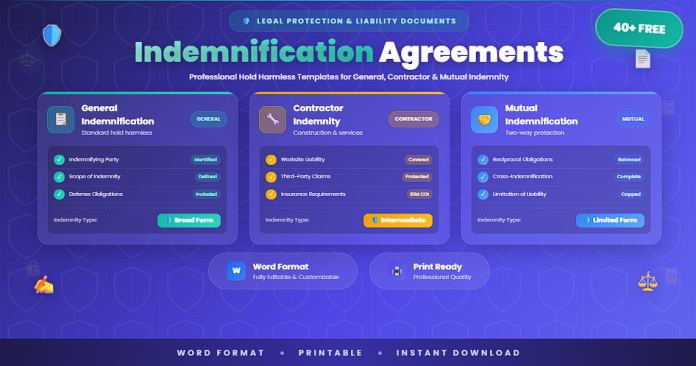

Indemnification agreements are essential in business, construction, vendor relationships, and professional services because they clarify who pays if something goes wrong. When a claim, lawsuit, injury, data incident, or property damage happens, indemnity clauses define which party must cover losses, legal costs, and third-party claims.
Without a clear indemnification agreement, disputes often arise around the scope of indemnity, the duty to defend, exclusions (such as negligence or intentional misconduct), notice deadlines, insurance coverage, and liability limits. That’s why free indemnification agreements in Word are valuable: they provide structured, editable formats that help organizations define risk allocation clearly and avoid expensive misunderstandings.
This guide includes 40+ free indemnification agreement templates suitable for contractors, consultants, vendors, landlords, events, SaaS providers, and partnerships.
What Is an Indemnification Agreement?
An indemnification agreement is a contract in which one party (the indemnifying party) agrees to compensate another party (the indemnified party) for certain losses, damages, liabilities, or legal costs arising from specified events.
A standard indemnification agreement typically includes:
✅ Parties and relationship context
✅ Definition of covered claims and losses
✅ Scope of indemnity (third-party claims, direct losses, legal fees)
✅ Duty to defend (who controls legal defense and counsel selection)
✅ Notice requirements and cooperation obligations
✅ Exclusions (gross negligence, willful misconduct, unauthorized acts)
✅ Liability limitations and caps (if applicable)
✅ Insurance requirements and proof of coverage
✅ Term and survival (how long obligations last)
✅ Governing law and dispute resolution
✅ Signatures and exhibits
Indemnity clauses are common in vendor contracts and service agreements to allocate risk fairly.
Why Use Free Indemnification Agreement Templates?
Templates help you draft consistent indemnity language without missing key protections.
✅ Clear risk allocation between parties
✅ Faster contracting and vendor onboarding
✅ Reduced disputes over legal defense responsibilities
✅ Better alignment with insurance policies
✅ Improved control of exclusions and liability caps
✅ More consistent legal documentation across deals
Templates are particularly useful for repeat vendor and contractor agreements.
40+ Free Indemnification Agreements (Word)
Below is a curated collection of indemnification agreement templates, grouped by use case and contract focus.
Core Indemnification Agreement Templates (1–14)
✅ Standard Indemnification Agreement Template
✅ Simple Indemnity Agreement (Basic)
✅ One-Page Indemnification Agreement
✅ Mutual Indemnification Agreement Template
✅ Unilateral Indemnification Agreement Template
✅ Indemnification Agreement with Duty to Defend Clause
✅ Indemnification Agreement with Notice and Cooperation Clause
✅ Indemnification Agreement with Exclusions and Carve-Outs
✅ Indemnification Agreement with Liability Cap (Basic)
✅ Indemnification Agreement Cover Page Template
✅ Indemnification Agreement Review Checklist
✅ Indemnification Clause Addendum Template (Attachable)
✅ Indemnification Amendment Template
✅ Indemnification Acknowledgment Receipt Template
Contractor, Vendor, and Service Provider Templates (15–28)
✅ Contractor Indemnification Agreement Template
✅ Subcontractor Indemnity Agreement (GC-to-Sub)
✅ Vendor/Supplier Indemnification Agreement Template
✅ Professional Services Indemnity Agreement (Consultant)
✅ Construction Site Indemnification Agreement (Basic)
✅ Equipment Rental Indemnification Agreement Template
✅ Maintenance Services Indemnity Agreement
✅ IT Services Indemnification Agreement (Basic)
✅ SaaS/Software Services Indemnification Agreement (Basic)
✅ Product Liability Indemnity Agreement Template
✅ Intellectual Property Indemnification Addendum (Basic)
✅ Data Protection and Cyber Indemnification Addendum (Basic)
✅ Client Hold Harmless Agreement Template
✅ Waiver + Indemnity Combined Agreement (Basic)
Real Estate, Events, and Specialized Templates (29–40+)
✅ Landlord/Tenant Indemnification Agreement Template
✅ Property Management Indemnification Agreement
✅ Event Venue Indemnification Agreement Template
✅ Event Vendor Indemnification Agreement (Catering, AV, Security)
✅ Volunteer Indemnification Agreement Template
✅ Transportation and Delivery Indemnity Agreement
✅ Medical/Healthcare Services Indemnity Agreement (Basic)
✅ Nonprofit Indemnification Agreement Template
✅ Partnership Indemnification Agreement Template
✅ Corporate Officer/Director Indemnification Agreement (Basic)
✅ Insurance Requirements Addendum Template
✅ Claims Notification and Incident Report Form Template
✅ Dispute Resolution Addendum for Indemnity Claims
✅ Complete Indemnification Agreements Pack (All-in-One)
Why Use Word Format for Indemnification Agreements?
Indemnification terms are often negotiated and tailored to specific risks—meaning edits and tracked changes matter.
Word format advantages include:
✅ Easy editing of covered claims and exclusions
✅ Revision tracking for negotiation and approval
✅ Flexible attachments for insurance certificates and addendums
✅ Professional formatting for signatures and records
✅ Easy PDF export for execution and archiving
Word is ideal for contract workflows that require collaboration and version control.
Best Practices for Indemnification Agreements
To create stronger indemnification agreements:
✅ Define covered claims clearly (third-party vs direct losses)
✅ Clarify whether there is a duty to defend (and who controls counsel)
✅ Set notice timelines and cooperation requirements
✅ Include exclusions and carve-outs (gross negligence, willful misconduct)
✅ Align indemnity with insurance requirements and coverage limits
✅ Consider liability caps and limitation-of-liability clauses
✅ Define claim handling steps (tender of defense, settlement approvals)
✅ Ensure survival language covers post-termination claims
The most important clarity is around defense control, exclusions, and insurance alignment.
Common Mistakes to Avoid
Avoid these frequent indemnity contract problems:
✅ Vague indemnity scope (“any and all claims”) without limits
✅ No defense clause (unclear who pays lawyers and controls litigation)
✅ Missing notice requirements or claim process
✅ Indemnity terms that conflict with insurance coverage
✅ No exclusions for misconduct or unauthorized actions
✅ No liability caps where appropriate
✅ No survival term (obligations disappear too early)
Most disputes come from unclear defense obligations and mismatched insurance.
Frequently Asked Questions
Is an indemnification agreement the same as a hold harmless agreement?
They’re related. “Hold harmless” often appears as part of indemnity language, but indemnification usually includes broader compensation and legal defense obligations.
Should indemnification agreements include a duty to defend?
Often yes, especially in vendor and contractor contexts. The contract should clearly state who pays legal fees and who controls counsel.
Do indemnity clauses cover negligence?
Sometimes. It depends on the wording and local law. Many agreements exclude gross negligence or intentional misconduct.
Why include insurance requirements in indemnity agreements?
Insurance helps fund the risks described in the indemnity clause. Aligning the two reduces gaps and disputes.
Why use Word templates for indemnification agreements?
Word templates are easy to customize, negotiate with tracked changes, and reuse across vendor agreements—then export to PDF for signing.
Conclusion
Indemnification agreements are core risk-management documents that clarify who is responsible for losses, claims, and legal defense when things go wrong. The 40+ free indemnification agreements in Word in this guide provide editable formats to define scope, exclusions, defense obligations, insurance requirements, and claim procedures consistently.
With the right template, businesses can reduce legal uncertainty, protect cash flow, and manage vendor and contractor relationships more professionally.

