When two or more parties want to collaborate, starting with clear written expectations is critical. A Memorandum of Understanding (MOU) helps define shared intent, responsibilities, and cooperation structure before moving into fully binding contracts.
Without an organized MOU, partnerships may face misalignment on goals, scope, timelines, and ownership of activities. Free Memorandum of Understanding templates in Word provide editable frameworks to document collaboration terms clearly and professionally.
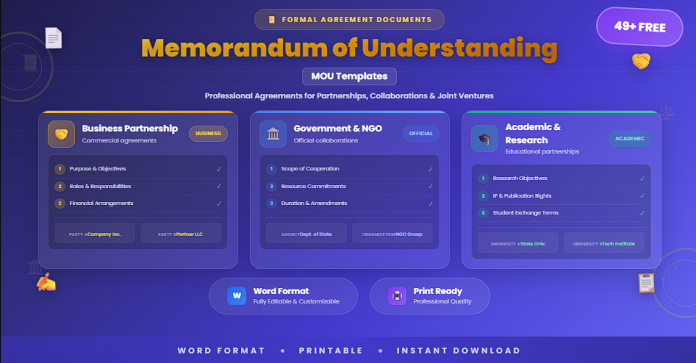
This guide includes 49+ free MOU templates for business partnerships, educational collaborations, nonprofit programs, service coordination, and cross-organization initiatives.
What Is a Memorandum of Understanding (MOU)?
A Memorandum of Understanding is a formal agreement document that records mutual understanding between parties regarding a proposed collaboration or relationship framework.
A standard MOU often includes:
- Party names and background context
- Purpose and objectives of collaboration
- Scope of cooperation
- Roles and responsibilities of each party
- Timelines, milestones, and governance approach
- Confidentiality and information-sharing terms
- Financial/resource commitments (if any)
- Duration, amendment, and termination terms
- Signatures and effective date
An MOU is often used as a structured foundation before detailed contractual execution.
Why Use Free Memorandum of Understanding Templates?
Using free MOU templates offers practical planning and documentation benefits.
Key benefits include:
- Faster drafting of collaboration frameworks
- Clear role and expectation alignment
- Better communication between partnering entities
- Reduced ambiguity before formal contracts
- Editable format for different sectors and use cases
- Reusable structure across recurring partnerships
Templates help teams formalize intent while maintaining flexibility.
49+ Free Memorandum of Understanding Templates (Word)
Below is a curated collection of MOU templates, grouped by partnership type and collaboration context.
Core and General MOU Templates (1–15)
- Standard Memorandum of Understanding Template
- Simple MOU Template
- One-Page MOU Format
- Editable MOU Agreement (Word)
- General Partnership MOU Template
- Cooperation Framework MOU
- Mutual Collaboration MOU Template
- Joint Intent MOU Form
- Strategic Alliance MOU Template
- Multi-Party MOU Template
- Internal Department MOU Template
- Cross-Functional Team MOU
- Basic Non-Financial MOU Template
- Formal Intent to Collaborate MOU
- Universal MOU Starter Template
Business and Commercial Collaboration MOUs (16–30)
- Business Partnership MOU Template
- Vendor Collaboration MOU
- Service Coordination MOU Template
- Joint Venture Discussion MOU
- Distribution Partnership MOU
- Marketing Collaboration MOU
- Technology Cooperation MOU
- Product Development MOU Template
- Startup Partnership MOU
- Consulting Collaboration MOU
- Franchise Cooperation MOU
- Research and Innovation MOU (Commercial)
- Cross-Border Business MOU
- Data Sharing and Cooperation MOU
- Pre-Contract Commercial Understanding MOU
Education, Nonprofit, Government, and Program MOUs (31–49+)
- School Partnership MOU Template
- University Collaboration MOU
- Internship Program MOU
- Training Partnership MOU
- Nonprofit Collaboration MOU
- Community Program MOU Template
- Grant Partnership MOU
- NGO Cooperation MOU
- Public-Private Collaboration MOU
- Government Agency Coordination MOU
- Healthcare Program Cooperation MOU
- Social Services Partnership MOU
- Event Partnership MOU
- Volunteer Program MOU Template
- Resource Sharing MOU
- Facility Use Cooperation MOU
- Joint Awareness Campaign MOU
- Program Implementation MOU
- Complete MOU Templates Pack
- MOU Review and Approval Checklist
Why Use Word Format for MOU Templates?
Word is ideal for MOUs because these documents often require revision, negotiation, and stakeholder input.
Word format advantages include:
- Easy editing for names, scope, and clauses
- Fast collaboration with tracked changes
- Reusable document structure for future partnerships
- Print-ready format for sign-off workflows
- Practical conversion into more formal agreements later
Word supports both drafting speed and governance consistency.
Best Practices for Drafting an Effective MOU
To build stronger MOUs:
- Clearly define collaboration purpose and scope
- Specify responsibilities for each party in measurable terms
- Add timeline milestones and review checkpoints
- Include communication and governance mechanisms
- Address confidentiality and information handling explicitly
- Clarify amendment and exit/termination process
- Confirm legal review when transitioning to binding contracts
A well-written MOU prevents ambiguity and builds execution alignment.
Common Mistakes to Avoid
When preparing MOUs, avoid:
- Vague objectives without defined scope
- Missing accountability for key activities
- Undefined timelines or deliverable expectations
- Overlooking confidentiality/data considerations
- No process for changes or dispute handling
- Treating MOU language as final contract language without legal review
Clarity and structure are essential for practical collaboration outcomes.
Frequently Asked Questions
Is an MOU legally binding?
It depends on wording and jurisdiction. Many MOUs express intent, while some clauses may still carry legal effect.
When should an MOU be used instead of a contract?
Use an MOU when parties need to formalize intent and cooperation structure before a full contract.
Can MOUs be used for nonprofit and education partnerships?
Yes. MOUs are widely used in schools, nonprofits, and community collaborations.
Why use editable Word templates for MOUs?
Word templates are easy to customize, review, and align with stakeholder feedback.
Can an MOU include financial responsibilities?
Yes. It can outline funding roles, resource commitments, or cost-sharing principles.
Conclusion
An MOU is a practical first step for structured collaboration. The 49+ free Memorandum of Understanding templates in Word in this guide provide professional frameworks to document shared intent, responsibilities, timelines, and governance expectations.
With the right template, organizations can align faster, reduce misunderstandings, and build stronger foundations for successful partnerships.

